
Key left inside the cabin
Automatic locking may engage unexpectedly. Check for spare-key or manufacturer-supported options before considering any physical intervention.
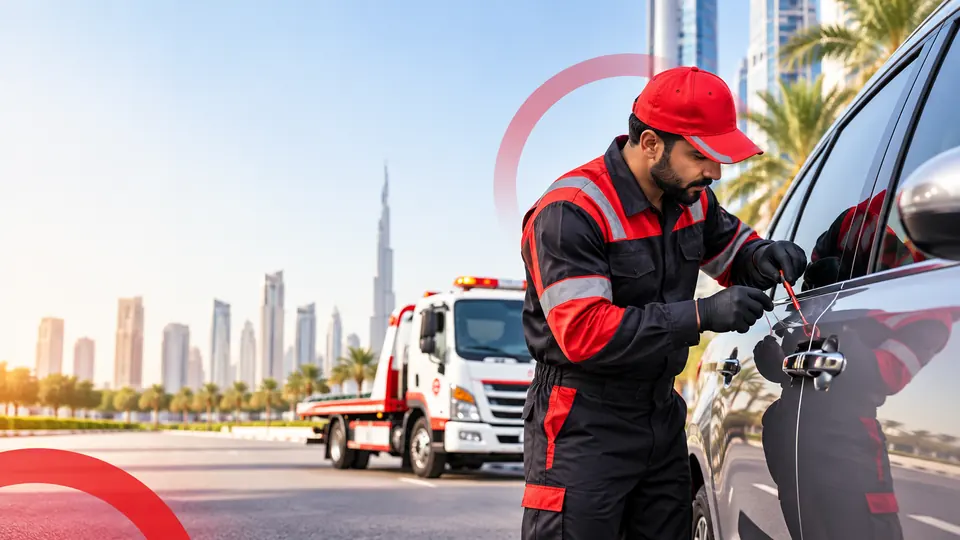
A vehicle lockout can be frustrating, but it rarely justifies forcing the door or breaking glass. First assess the safety of any occupants, then review manufacturer-authorised options and seek qualified assistance when required.
For a trapped child, person or animal exposed to immediate danger, contact official emergency services immediately.
Safety takes priority over access to the vehicle.
If a person or animal is trapped and at immediate risk, contact official emergency responders without delaying for a commercial unlocking service. Give them the precise location and follow their advice.
For a routine situation, check for a spare key and consult the manufacturer instructions for approved access options. Avoid improvised wires or hard tools near seals, windows and door mechanisms, which can damage safety equipment and electronics.
Remote battery failure, vehicle electrical problems and mechanical lock faults may produce similar symptoms. The exact car model and circumstances help a professional decide what assistance is appropriate.
Similar symptoms can come from different causes.
Automatic locking may engage unexpectedly. Check for spare-key or manufacturer-supported options before considering any physical intervention.
The cause may be the remote battery, vehicle battery or electronic fault. Refer to the manufacturer guidance or a qualified professional.
Unlocking alone may not restore driving; replacement or electronic programming requires additional specialised services and proof of ownership.
Do not force a stuck mechanism. Physical damage may worsen or create higher repair costs.
Preventing damage is important even when access takes a little longer.
Do not insert hard objects near glazing, airbags or wiring or apply pressure that may damage the door.
Share sensitive proof only with an appropriate authorised provider using private channels.
A responsible technician should verify that the requesting person owns or is authorised to access the car.
Prepare a clear, non-sensitive description before requesting help.
Call official emergency services when there is immediate danger rather than waiting for a routine provider.
Supply make, model, approximate year and whether the remote or mechanical lock is affected.
Registration, rental documents or appropriate authorisation may be needed.
Ask whether the issue is entry only, a lock repair or a missing-key replacement job.
These may be entirely different professional services.
When the original key is visible inside, the need may be limited to authorised cabin access. A lost or failed key can involve replacement, an immobiliser diagnosis and electronic programming.
Do not assume any tow-truck company offers programming or electronic lock repair by default. Confirm the provider’s actual capability before making a payment or dispatch request.
Start with basic information and supply documents only when asked through a suitable channel.
Address, map pin and any parking-facility details.
Manufacturer, model and approximate production year.
Keys inside, key lost or remote/key system malfunction.
Confirm provider availability, proof of lawful access and the service scope.
Avoid the most common incorrect assumptions.
No universal guarantee exists. Security systems and vehicle damage vary, and dealer assistance may sometimes be necessary.
Where immediate danger exists, contact official emergency services immediately and follow their instructions.
Yes. Legitimate ownership or authorisation should be checked before granting access.
Not necessarily. These are separate services with different equipment and procedures.
Share the vehicle location and its condition, destination and access information. Local service availability and pricing must be confirmed separately.