
Electric and permanent all-wheel-drive vehicles
Some models restrict towing with wheels on the ground. Consult the specific owner manual and use a permitted method rather than assuming that all EVs or AWD vehicles have identical requirements.
Equipment names often overlap, but transporting a damaged, electric or low-clearance vehicle requires specific checks. The vehicle manufacturer’s instructions and actual loading conditions take priority over a generic towing label.
Educational guidance; suitability, pricing and availability depend on the vehicle and location.
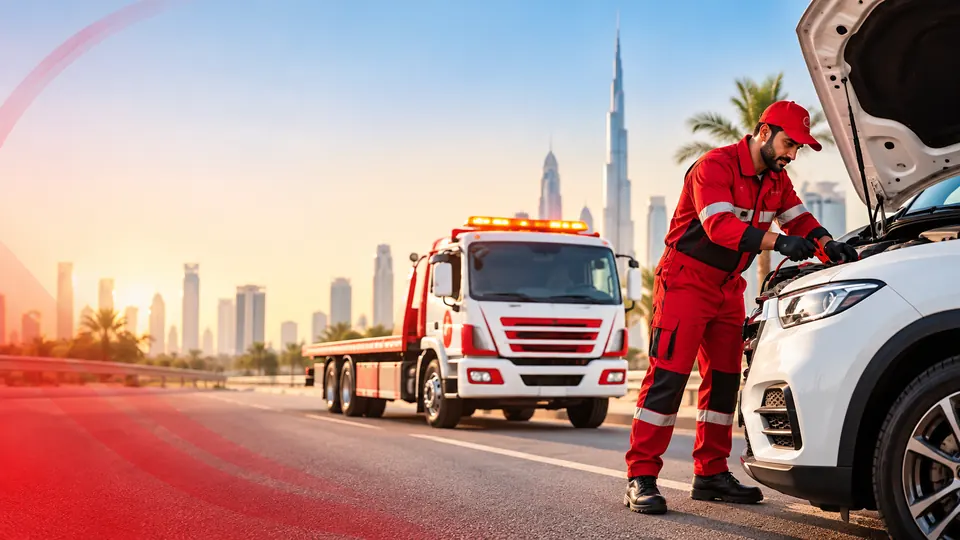
A flatbed platform carries the car with its wheels away from the road during the journey. A winch may be used to load it, but that does not mean its wheels are being dragged along the highway.
In everyday terminology, “tow truck” can describe several vehicles and recovery techniques. A wheel-lift arrangement and a full platform are not interchangeable for every drivetrain or vehicle condition.
Loading and transport must respect weight limits, manufacturer instructions, vehicle damage and access restrictions. There is no universally safe method for every model.
Some models restrict towing with wheels on the ground. Consult the specific owner manual and use a permitted method rather than assuming that all EVs or AWD vehicles have identical requirements.
Ramp angle, bumper clearance and loading aids can matter. Photos help identify whether a suitable platform and accessories are available.
A car that cannot roll may need special loading aids or handling. Dragging it without assessment can cause further damage.
Height restrictions, tight turning areas and steep ramps may prevent a conventional transporter reaching the car.
Vehicle weight, dimensions and cargo affect equipment capacity and road requirements; specialised arrangements may be needed.
Share make, model, year and any manufacturer towing instructions that you have.
Note locked brakes, wheel damage, suspension faults or an immobile vehicle.
Show a side view and the parking entrance or loading area when safe to do so.
Agree on the permitted loading approach, equipment availability, unloading location and quotation.
Securing points and methods should match the equipment and vehicle manufacturer guidance.
Locked wheels or damaged suspension may require a different loading technique.
Follow the instructions for the exact model before allowing wheel-based towing.
Accurate information helps the provider evaluate what equipment may be suitable.
Send map links for the current vehicle position and its intended garage or destination.
Give the make, model, visible damage, wheel condition and whether the transmission or parking brake is locked.
Show the surrounding road, parking entrance, ramp or sand surface where relevant. Only take photographs when safe.
Ask what the quoted work includes, the expected time, availability and any additional loading charges before confirming.
Not necessarily. The suitable method depends on the particular vehicle, access, condition and manufacturer requirements.
Consult the exact vehicle manual; some models require platform transport or another authorised method.
Special handling may be possible, but it requires a prior assessment and suitable loading aids.
The quote may differ according to equipment, distance, access and the vehicle’s condition.
Send your exact pickup and drop-off locations, vehicle details, photos and any loading constraints so that suitable equipment, availability and costs can be discussed.