
A passenger car resting on its underbody
A low-clearance car may need careful load relief and an exit plan rather than more acceleration.
If your vehicle is stuck around Mezyad and Al Yahar sandy approaches and trails near Jebel Hafeet, share GPS coordinates, approach-track images and the vehicle model before specialist recovery can be assessed.
Availability, suitable equipment, timing and price are assessed before accepting a job.
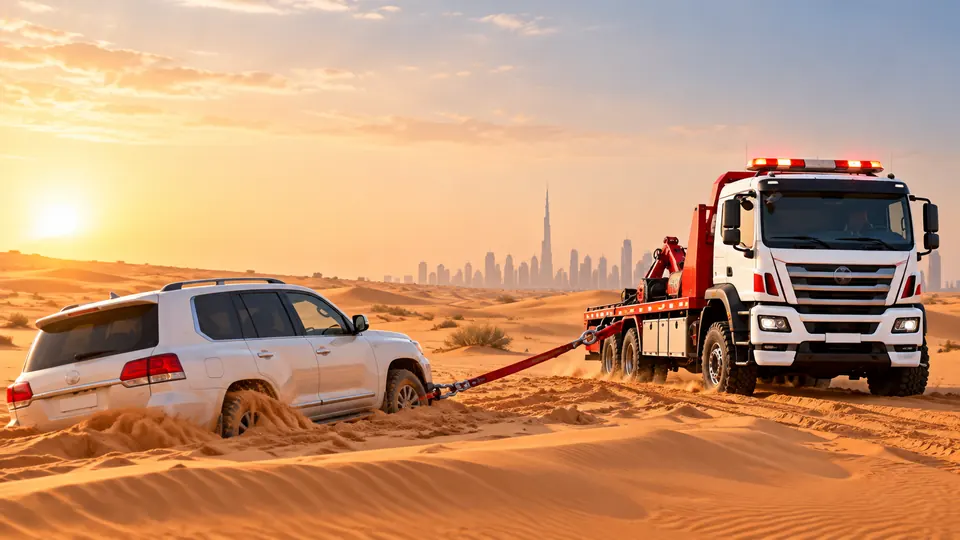
Repeated wheelspin can bury a car even deeper.
Ground conditions can alternate between loose sand, gravel and slopes. A trail a 4x4 entered may be impossible for a heavy flatbed to reach.
In the open desert around Al Ain, a standard carrier may not reach the vehicle. Send broad terrain images, wheel positions and the nearest usable paved-road access.
Never pull from an unapproved bumper or unknown hook. Keep bystanders away from tensioned recovery gear.
Safe access is the first equipment question.
A low-clearance car may need careful load relief and an exit plan rather than more acceleration.
A vehicle leaning on a slope requires special care; approaching an unstable edge to pull it can put passengers and operators at serious risk.
Soft mud can trap a second vehicle. Send photos of the approach before anyone attempts extraction.
GPS is more useful than the name of a broad desert area.
Ground conditions can alternate between loose sand, gravel and slopes. A trail a 4x4 entered may be impossible for a heavy flatbed to reach.
Sanaiya · Mezyad · Al Yahar · Al Faqa · Sweihan
Identify the actual entry point and distance from firm ground, plus any limited access or permissions.
camp approaches · sandy entrances · unsealed tracks
A tow truck is not necessarily built for dune extraction.
Approved recovery points, vehicle weight and depth of bogging determine whether specialist recovery is possible and whether a flatbed is needed afterward.
Vehicle weight, drivetrain, wheel and steering damage, and ability to drive afterward determine whether separate flatbed carriage is needed.
Call emergency services first if occupants face immediate danger.
Stop wheelspin and keep occupants away from unstable slopes.
Provide both the vehicle pin and the nearest stable access track.
Mention any wheel damage, steep angle or inability to move the vehicle.
Do not improvise high-tension pulls using unknown tow points.
Location and terrain matter more than a generic flatbed rate.
Recovery around Mezyad and Al Yahar sandy approaches and trails near Jebel Hafeet depends on distance from firm ground, dune slope, depth of bogging, weight and equipment access.
If extraction must be followed by flatbed delivery, confirm both stages and their prices before work is accepted.
Send these details for a safe assessment.
Include the desert trail entry and nearest solid road.
Show the wider slope, depth of sand and potential approach.
Share model, damage and whether the vehicle can drive afterward.
Specialist equipment, access and price must be agreed first.
Keep the priority on safe access and suitable equipment.
Send the exact GPS and terrain photos to check actual specialist availability.
Not necessarily; a separate extraction stage may be required first.
No. Terrain, distance, slope, vehicle weight and equipment all matter.
Do not attempt an improvised pull. Move occupants to safety and call emergency services if there is immediate danger.
Keep the last known GPS position and track entrance available and follow official emergency guidance if needed.
Vehicle details, location, safety and price must be checked before accepting the request.