
Tyres and axles
Review tyre condition, inflation, load rating, damage and the axle or suspension condition. Seek qualified inspection for suspected faults rather than starting a road trip.
Before arranging trailer towing or moving a static caravan, check its true dimensions, total mass, tyres, hitch, fixed accessories, internal loads and site access. Accurate details help identify appropriate equipment and reduce avoidable delays or damage.
This is a preparation guide, not a roadworthiness certificate. Trailer safety and legal requirements still require qualified verification.
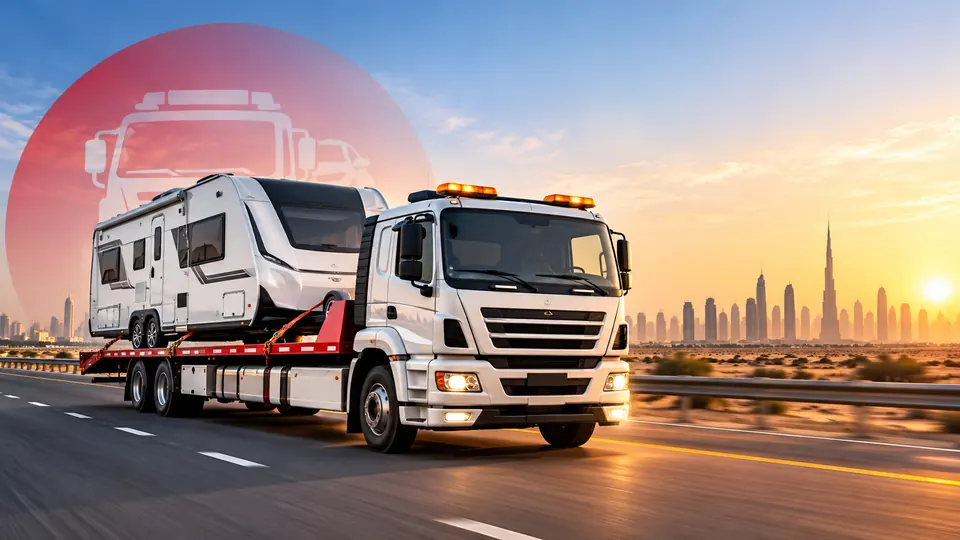
A trailer can be larger and heavier than its photos suggest.
A small camping trailer differs from a static cabin mounted on supports, and a fully loaded caravan differs from an empty one. You need to understand gross load, the trailer chassis, axle condition and the permitted tow-vehicle combination before deciding whether it can travel on its own wheels.
If you do not have trustworthy mass data or safe lifting points, avoid guesswork and improvised straps. A qualified inspection may be needed before a static unit can be loaded or a caravan can be towed.
Plan collection and delivery together. Determine who hands over the keys, where the carrier may stop, whether a gate or tight bend is involved and what kind of ground lies at the final unloading point.
Measure the entire unit as it will travel, including fixed accessories.
Include the towing drawbar, rear storage racks and any fixed projection.
Include mirrors or equipment that cannot be safely folded or removed.
Measure rooftop air-conditioning, antennas, solar fittings and other fixtures, not only the walls.
Use a plate, manufacturer record or trustworthy weighing information; do not estimate from appearance.
Show chassis, base, tyres and hitch so a qualified operator can assess the loading approach.
Having wheels is not enough to make a caravan roadworthy.
Review tyre condition, inflation, load rating, damage and the axle or suspension condition. Seek qualified inspection for suspected faults rather than starting a road trip.
The coupler, trailer mass, tow-vehicle capacity and any required safety connections must be compatible. Never rely on an improvised towing arrangement.
Check working brakes and signals, identification and current registration or permission requirements applicable to the specific trailer and route.
Do not drag a fixed cabin on the ground. Its structure, lifting points, carrier capacity and securing arrangements need separate assessment.
Contents can shift or be damaged even during ordinary, smooth transport.
Lock or secure cupboards, drawers, doors and windows, and protect heavy or breakable contents according to manufacturer instructions.
Follow approved procedures for disconnecting and securing services, tanks and gas systems. Use qualified help where needed.
Check awnings, steps, satellite dishes and roof fixtures; secure movable equipment in its approved travel position.
Remove valuables and prohibited or unsafe loads, and agree responsibilities for any remaining contents.
The difficult part of a journey may be the last hundred metres.
Photograph both sides of the entrance and identify any height restrictions, overhead cables, trees, tight turns or sloping approaches. Large carriers may require generous turning room even when the road itself is wide.
Where sand, mud, steep ground or narrow trails are present, agree a safer alternate drop-off location. Do not direct heavy equipment onto unknown soft ground or stand close to suspended loads or moving vehicles.
For campsites, compounds, yards and farms, confirm entry permissions, truck access times and delivery responsibilities before fixing a schedule.
Clear responsibilities and records make the handover more reliable.
Record all sides, wheels, supports and existing damage before handling or loading.
Confirm the collection contact, receiving person and accurate location pins.
Check whether loading, securing, unloading, waiting and applicable permit arrangements are included.
Review the visible condition and accessories against the departure record before final acceptance.
A short and complete brief can prevent the wrong equipment being sent.
Towable trailer, static caravan, camping pod or powered motorhome.
Complete length, width, height and known or documented gross mass.
Views of the body, wheels, hitch or base and access restrictions.
Collection and delivery pins, required dates and any site-entry limitations.
No. Tyres, axles, hitch, brakes, vehicle ratings and applicable legal requirements must be satisfied.
Yes. Total height including air-conditioning and other protrusions affects the carrier and route.
Obtain reliable manufacturer information or qualified assessment; do not simply guess.
No. Access, ground strength and a suitable unloading point require assessment.
No, it is general preparation guidance and not a substitute for professional inspection or legal compliance.
Dimensions, load mass, tyre condition, access photos and both location pins allow a more reliable transport and quote assessment.