
Loose sand with deeply spinning tyres
Repeated throttle can increase the depth of a rut. Explain whether the wheels or underbody are buried.
Sand recovery varies with slope, vehicle clearance, terrain and how deeply the wheels are buried. Protect people and avoid worsening the situation before considering an extraction.
Educational guidance; suitability, pricing and availability depend on the vehicle and location.
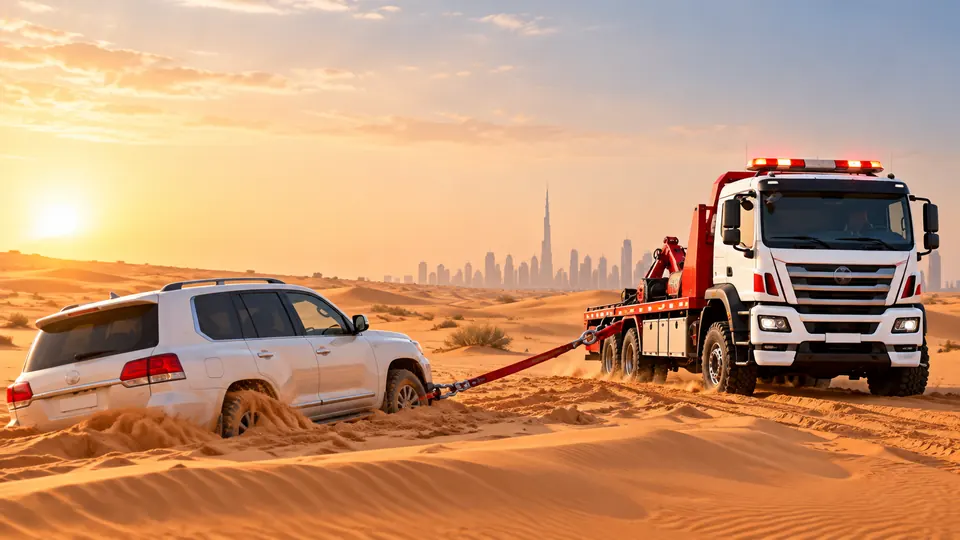
If the wheels spin without moving the vehicle, heavy throttle may dig it deeper. Stop and assess from a safe position whether the chassis is resting on sand or the vehicle is on a slope or unstable ground.
Keep people out of the path of tensioned ropes, straps or recovery equipment. In remote hot conditions, prioritise drinking water, communication and an accurate location; contact official emergency services if anybody is at risk.
This page is not a guide to rigging recovery ropes or improvised pulling points. Equipment under load can cause serious injury. Specialist assessment and rated equipment are important.
Repeated throttle can increase the depth of a rut. Explain whether the wheels or underbody are buried.
Vehicle sliding or rollover hazards can change the recovery plan. Do not attempt a high-force pull without a qualified assessment.
Soft ground may not support heavy equipment; access and safe footing must be evaluated.
A car grounded on sand may not respond to wheel movement. Report any fluid leak or visible underside damage.
Four-wheel drive does not prevent getting stuck, and recovery points vary by vehicle.
Unknown ratings and unsuitable attachment points can lead to components failing violently.
Keep bystanders clear and follow the qualified recovery team’s instructions.
An unstable car may slide or roll if moved without planning.
Share coordinates and an accessible paved-road entry point when possible.
This helps evaluate an approach route rather than assuming a heavy truck can reach the dune.
Include the wheels, vehicle slope and surrounding terrain; do not put yourself at risk for a picture.
Make, drivetrain if known, how deeply it is stuck, slope, damage and any passenger safety issues.
Off-road extraction has different risks and pricing factors from short local on-road towing.
Accurate information helps the provider evaluate what equipment may be suitable.
Send map links for the current vehicle position and its intended garage or destination.
Give the make, model, visible damage, wheel condition and whether the transmission or parking brake is locked.
Show the surrounding road, parking entrance, ramp or sand surface where relevant. Only take photographs when safe.
Ask what the quoted work includes, the expected time, availability and any additional loading charges before confirming.
If the tyres spin without progress, repeated throttle may bury the car further. Stop and assess the situation safely.
No. Incorrect attachment points can fail, cause damage or injure people. Manufacturer guidance and qualified recovery practices matter.
No. Access depends on vehicle and terrain, and a specialist off-road recovery approach may be needed.
No. Terrain, distance, risks and suitable equipment can change the price significantly.
Send your exact pickup and drop-off locations, vehicle details, photos and any loading constraints so that suitable equipment, availability and costs can be discussed.