
Vehicle sunk into soft, loose sand
Continuous spinning can dig deeper until the underbody rests on the sand. Wide and close-up photographs help determine what prevents movement and whether there is a safe extraction route.
A stuck car requires a proper assessment of the terrain, vehicle weight, recovery points and safe access. Share clear photos and a location pin so the appropriate extraction approach can be discussed.
AED 50 starting prices for selected simple local towing jobs do not apply automatically to off-road or sand recovery.
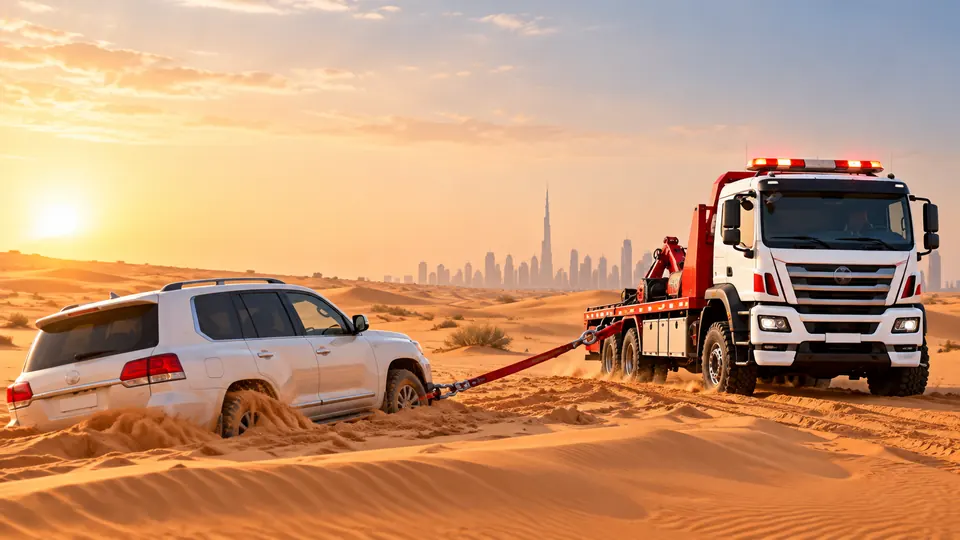
Repeated wheelspin can turn a mild traction problem into deep underbody grounding.
Whether a car is trapped beside an unpaved access road or a four-wheel drive is stranded in dunes, the first useful information is its exact GPS location and the condition of the ground. Please share a wide site picture, photos of the wheels and the clearance beneath the vehicle.
A small saloon car, crossover and fully equipped 4x4 present different challenges. A winch, another recovery vehicle or a flatbed after extraction may be appropriate, depending on the terrain and actual condition. It is not safe to assume one method suits every vehicle.
Remote recovery remains subject to legal and safe access, operator availability and suitable equipment. A confirmed service time or fixed quote requires assessment rather than a promise based on the neighbourhood name.
Different off-road situations require different site and vehicle assessments.
Continuous spinning can dig deeper until the underbody rests on the sand. Wide and close-up photographs help determine what prevents movement and whether there is a safe extraction route.
Inclines change the risks around vehicle stability and the pulling direction. A qualified operator needs to consider the slope, stable anchor arrangements and a safe path away from the dune.
A bumper, exhaust or underbody can contact the sand before the tyres regain traction. Check for visible damage or leaks after extraction and avoid further driving if the vehicle appears unsafe.
Soft ground can trap not only the stranded car but also a recovery truck. The accessibility and load-bearing condition of the track should be reviewed first.
When the vehicle is resting on its underside, more throttle may make the situation worse. A professional needs to assess the position and suitable equipment rather than rely on one generic technique.
Proximity to water, ditches, structures or weak ground can limit safe access. Always share surrounding terrain, permission or access requirements and the nearest firm road.
Clear information helps the operator assess feasibility and cost.
Send a map pin, nearest paved road and practical entry details; a broad area name is rarely precise enough.
Include front and side views, ground conditions, slopes and potential obstructions.
Tell us the model, driveline type if known, engine condition, visible damage and whether any passengers are at risk.
The operator should confirm feasibility, approach and any distance or special-access charges before dispatch.
Do not keep driving if there are fluid leaks, tyre damage, unusual noises or steering problems. Towing to a workshop may be safer.
These are general safety principles, not remote operating instructions for a vehicle recovery.
If the car is not making progress, continuing to spin its wheels can worsen the depth of the rut and vehicle position.
Incorrect recovery points or under-rated gear can fail suddenly and seriously injure bystanders. Stay clear of tensioned ropes and leave rigging to properly equipped specialists.
A rescue attempt may strand an additional car. Evaluate safe approach and exit routes before moving equipment toward soft ground or a steep slope.
If anyone needs urgent medical help, is exposed to dangerous conditions or cannot communicate reliably, contact the appropriate emergency service first and share your coordinates.
Coverage is reviewed against road access, equipment suitability and actual crew availability.
Enquiries may relate to the outer districts, unpaved plots or sandy access tracks near Al Jurf, Al Helio and Al Hamidiya. A precise pin and photographs are more useful than repeating a neighbourhood name. Requests outside the Ajman area must be assessed individually.
Liwa and Tal Moreeb are located in Abu Dhabi’s Al Dhafra Region, not in Ajman. Seasonal caravan transport to Liwa is a distinct long-distance logistics request; see the dedicated page if that is what you need.
Off-road recovery is not covered by the AED 50 starting price for some short, simple local tow jobs.
A quote depends on travel and access distance, sand or mud conditions, vehicle size, how deeply it is stuck, the crew and equipment required and whether the vehicle also needs flatbed transport to a workshop.
Share a map pin and photographs before any dispatch is agreed. Confirm the scope of work, whether an extraction or onward transport is needed and the total charge or any clearly explained conditions before service begins.
Call or WhatsApp the location and photographs for a practical assessment of assistance, equipment and pricing.
Send accurate coordinates, the nearest solid road and a clear entry route.
Show the whole vehicle and terrain, the sunk wheels and the approach from a firm road.
Ask what the service includes, any restrictions and the final agreed price before dispatch.
Practical answers on stuck vehicles, 4x4 recovery, costs and safety.
It can be assessed using the location, slope and vehicle photos. Work is confirmed only when equipment and safe access are suitable.
The correct method depends on how the vehicle is stuck. A flatbed may be needed after extraction, but does not replace the necessary off-road equipment.
No. That starting price refers to selected simple local towing jobs. Sand extraction has a separate quote based on the actual situation.
Send a clear GPS location, an overview of the terrain and close-ups of the wheels, underbody clearance and approach road.
Prioritise safety and call the appropriate emergency services. Provide exact coordinates and avoid hazardous improvised recovery attempts.
Send the model, terrain and clear GPS coordinates so the feasibility, equipment and quoted cost can be assessed first.