
Loose dune sand
Avoid repeated wheelspin that sinks the vehicle further. Keep bystanders away from any potential recovery line.
If your car is stuck in sand or mud, share coordinates and safe photos so the terrain and possible extraction method can be assessed.
Availability, method and price are checked before confirming the job.
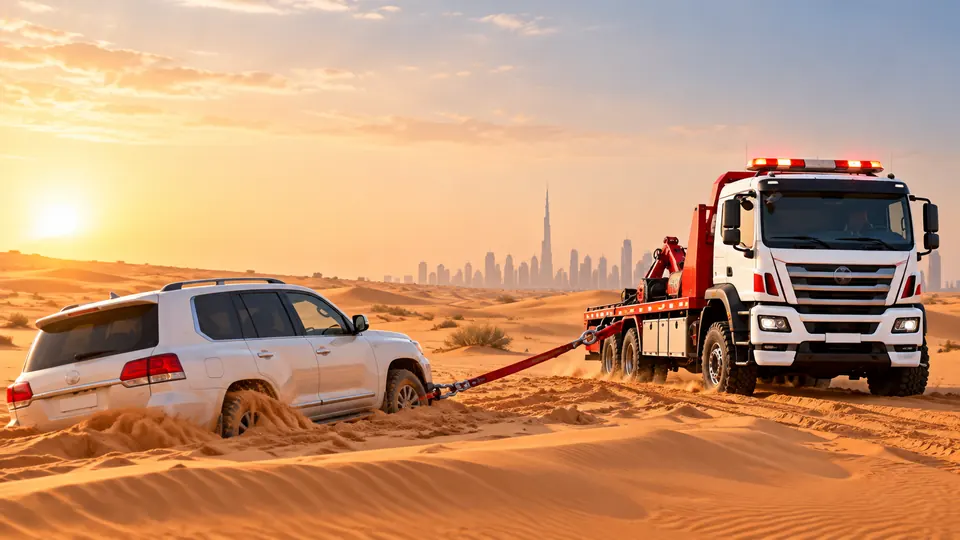
The first task is to understand the ground beneath the vehicle.
A 4x4 bogged at a campsite or a passenger car on soft coastal sand needs a different extraction plan from a routine roadside breakdown. Supply a GPS location, photos taken from safe ground and an explanation of the terrain.
An accessible paved road nearby does not ensure that recovery equipment can reach the vehicle. Coverage and safe access are assessed before a booking is confirmed.
Different surfaces change traction, anchor points and recovery risk.
Avoid repeated wheelspin that sinks the vehicle further. Keep bystanders away from any potential recovery line.
Traction can change suddenly; a stable recovery position is essential.
Tides and saturated ground may create major equipment hazards. Do not drive a second vehicle into unstable ground.
Know the last safe paved approach and describe any steep banks, ditches or rocks.
A precise pin is more important than the name of a nearby attraction.
In inland areas around Falaj Al Mualla, equipment may need a long approach on approved tracks. Near coastal campsite entrances, assess soft soils, tide exposure and local access restrictions.
Never enter protected or closed land on the assumption that recovery trucks have special permission. Local authorities’ restrictions must be respected.
Do not improvise a recovery from an unsuitable point.
Repeated acceleration can worsen wheel burial.
Keep people away from straps, cables and moving vehicles.
Only use equipment and recovery points that are rated for the task.
Provide the vehicle type, conditions and GPS pin.
Extraction and onward transportation may be separate services.
A trained team may determine that a recovery winch or another suitable vehicle is needed for extraction, and a flatbed afterwards if the car can no longer be driven safely.
A conventional crane is not automatically suitable for sandy terrain. Load, rigging, ground stability and permissions all need separate assessment.
The difficulty of reaching and extracting the vehicle matters more than a simple towing distance.
Factors include depth of bogging, vehicle weight, ground type, terrain access, number of affected vehicles and whether onward transport is needed.
Ask which phases are included in the quote; prices for a routine urban flatbed should not be assumed to cover a dune recovery.
Getting unstuck does not prove that the vehicle is roadworthy.
If wheels, underbody, steering or cooling components are damaged, arrange assessment rather than driving away. Be especially cautious about electrical systems exposed to water.
Share the information that guides a safe equipment decision.
Send your location and nearest safe access route.
Show how far the wheels have sunk and the surrounding ground.
Model, approximate mass and whether 4WD works.
Confirm whether further transport to a garage may be needed.
Practical answers to help you request the appropriate service.
Share GPS coordinates, photos and vehicle details with 0522450678.
Safe access, tide, location permissions and equipment must be evaluated first.
No; some tie-down or transport eyes are not rated for high-force recovery.
It may be a separate part of the job and should be clarified in the quote.
Share your pickup location, vehicle condition and destination so equipment, availability and pricing can be checked before booking.