
A sedan bogged beside a sandy access lane
Lower clearance can cause the chassis to settle into the ground. Forcing the engine to escape may damage exposed parts, so identify the nearest solid ground and whether the wheels remain functional.
A car trapped in dunes, loose sand or a remote desert track needs a different approach from roadside flatbed towing. Share GPS coordinates, wide terrain photos, close-ups of the wheels and the vehicle model before specialist availability and the job can be assessed.
No remote extraction is guaranteed without a safe access route, suitable equipment and confirmation of the operation.
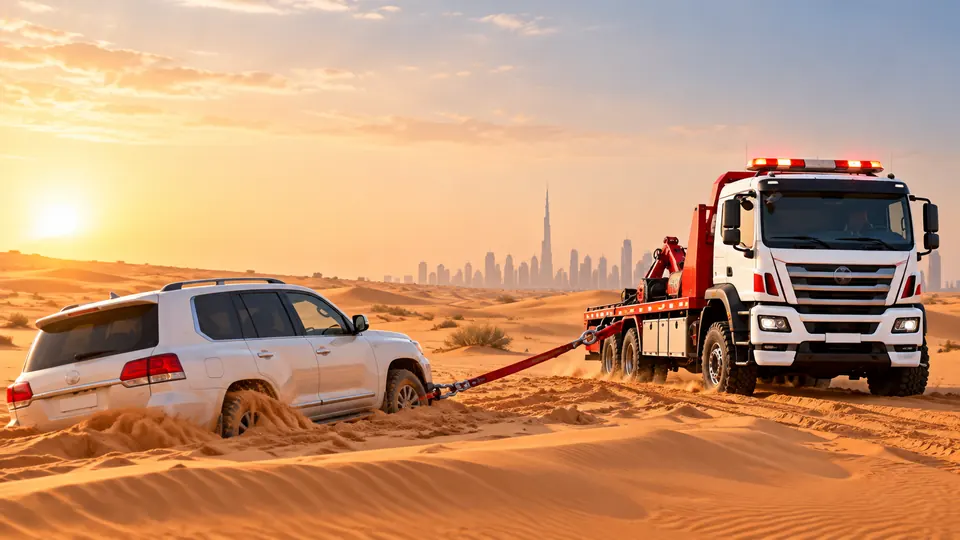
Soft sand, steep dunes and muddy tracks create very different risks.
When the tyres spin without progress, repeated acceleration may push the wheels and underbody farther into the sand. Stop forcing the vehicle, check whether it is leaning or resting on the chassis, and avoid using an unknown tow hook or pulling on a bumper.
An off-road recovery enquiry may require a qualified 4x4 crew or specialist winching equipment, followed by a flatbed transfer if the vehicle cannot safely drive away. Provide a wide photograph of the nearest stable access track, the dunes around the car and close images of each affected tyre.
If passengers face injury, serious heat exposure, dehydration or another immediate hazard, contact emergency services first. Keep your coordinates ready and do not wander away from a safe location without a suitable plan.
Desert vehicle extraction starts with understanding the ground beneath the car.
Lower clearance can cause the chassis to settle into the ground. Forcing the engine to escape may damage exposed parts, so identify the nearest solid ground and whether the wheels remain functional.
The direction of the slope, vehicle lean and room for a second vehicle affect the risks. Unrated ropes and improvised tow points are especially dangerous under load.
Mud may be much deeper than it appears. Photograph the approach and note whether other vehicles can safely reach solid ground without becoming trapped themselves.
People, equipment, tents and cables near the stuck vehicle require a clear protected work area. Images showing the exit route can help determine whether safe recovery is realistic.
A place name alone rarely identifies a specific vehicle among dunes.
Share both the vehicle pin and the entrance from the paved road. Protected areas and restricted land may have access regulations; a commercial operator cannot assume entry permission.
Al Wathba · Camping tracks · Unpaved approaches
A large carrier may not be able to follow a narrow unpaved track. Show the final reliable roadway and any steep or unstable ground between it and the vehicle.
Al Khatim · Al Khaznah · Desert approach roads
Western locations can be distant and isolated. A rescue request there must be reviewed for reachability, qualified crew, route, timing and equipment separately from a city job.
Al Dhafra · Liwa · Western desert routes
A carrier may be required later, but it is not automatically the right rescue vehicle.
A specialist must decide pulling method, attachment points and safe working area after reviewing vehicle weight, direction of movement and the terrain.
If the car has wheel, gearbox or underbody damage, recovery from the sand and subsequent road transport may become two separately scoped tasks.
Restricted land, heavy loads, steep grades and unstable slopes may exceed available equipment or require special permission. An enquiry does not itself confirm that a job can be safely completed.
Keeping passengers away from the potential pulling path is critical.
Repeated attempts can bury tyres or increase the risk of slipping on a steep slope.
Share the nearest paved road and photographs of the approach, not only a campsite name.
Show the underbody, wheel depth, slope and any apparent mechanical damage without standing in danger.
Keep bystanders away from loaded straps and let qualified personnel plan any controlled recovery.
A complex sand extraction cannot be priced like an ordinary flatbed trip.
The quote depends on the true distance from a usable road, sand condition, severity of grounding, vehicle size, specialist access and whether more than one stage is required. A damaged car may also require onward carriage to a repair facility.
For a nearest sand recovery or desert winch enquiry, send GPS, clear photographs and vehicle details. Ask whether the quoted scope ends on firm ground or includes a separate carrier journey to your destination.
Send the information needed to decide whether assistance is feasible.
Include a reliable route entrance and the nearest accessible road.
A wide view and close views showing the level of grounding.
Specify whether the car is a 4x4 or sedan and if it can drive after extraction.
Access, safety, equipment and the full job quotation must be reviewed before acceptance.
Practical guidance before seeking specialist extraction.
Yes, provide GPS and photographs. Actual service depends on permissible site access and suitable crew and equipment.
No location should be assumed covered without checking distance, access and operational availability.
Not necessarily. Specialist extraction may be required before loading the car onto a road carrier.
No. Terrain, access, vehicle position, equipment and distance determine the job scope and quotation.
Avoid movements that could cause a rollover, call emergency services when people are at immediate risk and seek qualified assessment.
Location, access, suitable equipment and the final quotation must be confirmed before dispatch.