
Soft or wet coastal sand
Wet sand and tidal conditions can make seemingly firm ground unsuitable for heavy equipment; assess water and access restrictions first.
Stuck in coastal sand, loose gravel or a Fujairah mountain track? Share safe photos and GPS coordinates to assess access, appropriate equipment and the quote.
Share your pin and photos to confirm suitability, availability and price.
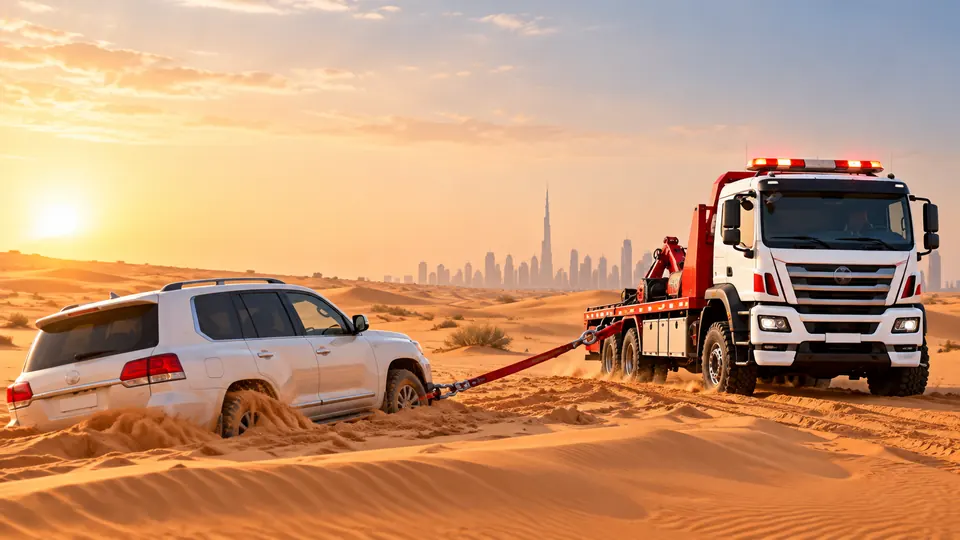
An off-road incident in the Hajar foothills is not necessarily a desert dune extraction.
A 4x4 may become stuck on a gravel track, in shoreline sand or on the approach to a rocky valley. Recovery depends on depth, traction, slope and whether a suitably equipped vehicle can reach a safe position.
If the vehicle is near a steep drop or unstable ground, occupants and responders come first. Supply GPS coordinates and safe photographs rather than attempting a risky pull. Access to reserves or restricted tracks may require official permission.
The surface changes the available recovery options.
Wet sand and tidal conditions can make seemingly firm ground unsuitable for heavy equipment; assess water and access restrictions first.
Wheel placement against stones, punctures and damaged underbody parts may prevent normal extraction and require a specialist approach.
Flash flooding is a serious hazard. Never enter flowing water or a flooded channel to attach a tow line.
Vehicle stability and safe anchoring are critical when a car is off a narrow mountain approach or unable to turn.
The last safe access point can be more important than the distance from a main road.
Inland areas such as Masafi, Al Bithnah and Wadi Ham have access roads with differing gradients and surfaces. Send the last reliable road connection as well as the actual vehicle pin.
Around Al Bidyah, Al Aqah and Dibba Al Fujairah, shoreline access and protected zones require care. Khor Fakkan and Kalba belong to Sharjah, so verify the administrative location rather than relying on the term east coast.
These points are for initial safety, not an instruction to conduct a self-recovery.
Continuing to accelerate can dig the vehicle deeper or damage components.
Keep passengers away from tow lines, unstable slopes and passing vehicles.
Leave wadi channels if rain or flowing water is present; contact official rescue services if endangered.
Provide photographs and GPS only from a position that does not expose you to additional danger.
Unrated attachment points and unsuitable straps can fail violently under load.
Extraction and subsequent vehicle transport may be two different jobs.
The vehicle’s mass, driven wheels, tow points and available approach determine whether recovery equipment is suitable. Do not assume every breakdown truck is equipped for rocky wadi extraction.
After the vehicle reaches firm ground, a damaged tyre, suspension or drivetrain may still require a flatbed to a repair workshop.
A remote extraction needs a case-specific quotation.
Access distance, slope, terrain, equipment needs and time all influence price. Reaching a vehicle in a dry gravel track is not equivalent to recovering one from an unsafe wadi or shoreline.
Confirm what the quote includes and whether transport to a workshop after extraction is a separate service. Prices for short urban towing do not automatically cover off-road rescue.
A freed vehicle may still be unsafe to drive.
Inspect visible tyre damage, fluid leaks and steering problems before deciding whether to drive. For onward transport, state the vehicle condition and workshop destination so loading can be assessed.
Pickup points near inland tracks and remote beach approaches should include the nearest safe meeting point and an authorised collection contact.
Provide the location and conditions before confirming service.
Pin the vehicle and identify the nearest reachable public road.
Show terrain, wheel position and access route without approaching an unstable edge.
Specify vehicle model, drivetrain and whether it starts or rolls.
Ask about access, suitable equipment, availability and the total quote.
Questions about sand, wadi terrain and safe vehicle extraction.
Submit your location and photographs for an availability and feasibility assessment.
Not usually. Fujairah is predominantly mountainous with gravel, wadis and local beach sand.
No. Avoid flood-prone channels and use official emergency services if anyone is at risk.
No. It depends on access, ground conditions, equipment and any subsequent transport needed.
GPS coordinates, safe photos of the surrounding ground, model and wheel condition.
Access must comply with regulations and permissions; entry cannot be assumed.
Send the vehicle pin, model, parking position and destination to confirm the service and quote.