Sharjah · dunes and unpaved tracks

Sand Recovery in Sharjah for Cars Stuck in Desert Terrain

A car bogged down near Mleiha or the Al Badayer dunes may need more than a tow truck. Share exact GPS coordinates, terrain photographs and the vehicle condition so access and appropriate recovery equipment can be assessed before any job is confirmed.

Remote extraction is assessed separately from ordinary city transport. Neither arrival time nor cost can be guaranteed without checking terrain, distance and equipment availability.

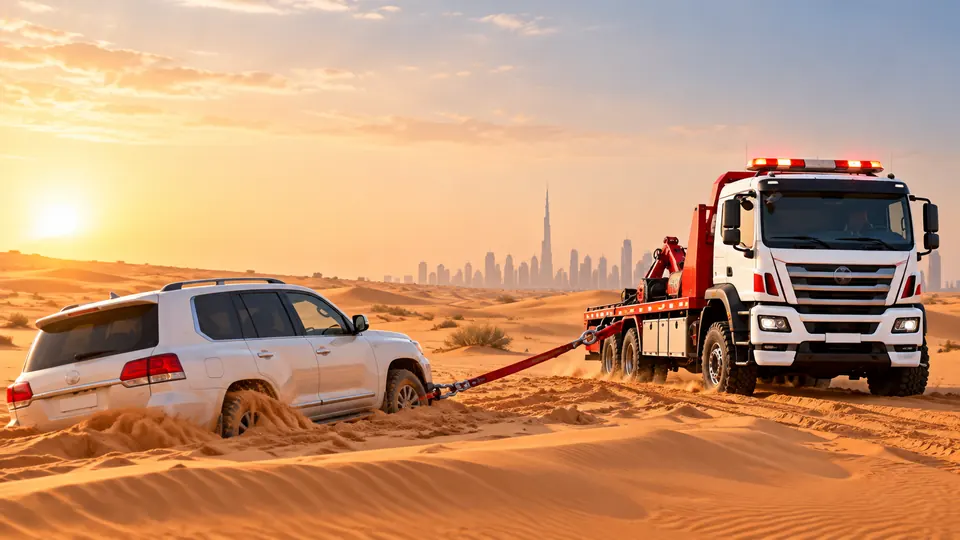
Illustration of an off-road sand recovery situation
AI-generated illustration, not a documented company job.
Sharjah enquiries subject to coverageSuitable equipment assessed per request0522450678

What makes a desert recovery different from roadside towing?

An SUV resting on its underbody behind a dune is not equivalent to a sedan bogged down beside a paved access road.

Soft sand can remove traction from a perfectly functional vehicle. Continued wheelspin may deepen the ruts, especially when the chassis has settled on the sand. A steep slope, unstable surface or a vehicle leaning sideways also changes the risk of recovery and the space needed for specialist equipment.

People searching for a sand recovery truck, off-road assistance or a winch-out service in Sharjah need a realistic evaluation, not an assumption that any available flatbed can cross dunes. Provide GPS coordinates, a wide view of the terrain, close views of all affected wheels and the nearest accessible road.

If passengers face injury, serious heat exposure or another immediate danger, contact emergency services first. Unrated straps and unknown tow points can fail under load, making improvised recovery dangerous to people nearby.

Soft sand, steep dunes, muddy ground and campsite tracks

Each setting presents different access and extraction constraints.

Wheels buried in loose sand

The vehicle can sink further when its wheels spin without traction. Do not attach improvised pulling gear to fragile body panels or unidentified parts. Keep people clear of any tensioned recovery line used by qualified personnel.

Sloping dunes and unstable edges

The approach direction, slope and ability to secure a recovery vehicle must be assessed before work. Moving a stranded car the wrong way could cause sideways movement or rollover.

Mud and soft ground after rain

Wet or waterlogged surfaces can hide poor supporting ground. Show the depth and surroundings in photographs and avoid sending a second unprepared vehicle into the same conditions.

Narrow access to desert camps

A camp entrance may have room for one vehicle but no turning area for specialist equipment. Share the entire track, nearby tents and the safest exit back to a stable road.

Mleiha, Al Badayer and inland Sharjah: location matters

A place name helps orientation, but a precise pin and legal access route are required.

Mleiha desert and surrounding tracks

Some tracks approach sand dunes or geological features where access restrictions may apply. Provide the closest paved-road entrance and do not assume recovery vehicles may enter protected or restricted land.

Mleiha · Fossil Rock vicinity · Permitted desert access tracks

Al Badayer and dune terrain

Al Badayer is known for its dune driving terrain. Describe whether the car is on a steep crest, between dunes or near an identifiable access road so that vehicle access can be considered responsibly.

Al Badayer · Big Red vicinity · Camping tracks

Al Dhaid, Al Madam and inland approaches

Distances and track conditions may differ significantly from central Sharjah. Remote coverage must be confirmed before any arrival commitment can be discussed.

Al Dhaid · Al Madam · Farm access roads

Off-road extraction equipment or a flatbed transporter?

A flatbed may be useful after freeing the car; it is not automatically an extraction solution.

Recovery from a fixed, buried position

Extraction may require rated recovery equipment, suitable anchor points, experienced operators and a safe line of pull. Vehicle weight and traction cannot be assessed from appearance alone.

Vehicle damage discovered after recovery

If a wheel, suspension or drivetrain is damaged, the vehicle may need subsequent transport on an appropriate carrier. Specify whether the enquiry covers extraction, road transport or both.

Terrain outside safe equipment limits

Extreme slopes, heavy vehicles and unstable ground may require a specialist provider or multiple vehicles. Every job must be evaluated against real operating capability, safety and local permissions.

Safety priorities while waiting near desert tracks

Protect occupants first and avoid worsening the vehicle position.

  1. Stop aggressive wheelspin

    Do not continue attempts that deepen the ruts or destabilise a vehicle on a slope.

  2. Keep accurate coordinates

    Share a live map pin and the nearest usable road or track entrance, not just a landmark.

  3. Describe the passengers and the car

    State any injuries, heat exposure, low water supplies, vehicle tilt and visible damage; contact emergency responders when appropriate.

  4. Avoid improvised pulling

    Do not attach ropes to unverified points or stand near equipment under tension; await suitable trained help.

How is sand recovery in Sharjah priced?

The terrain and extraction requirements can matter more than distance alone.

The quote depends on the approach route, distance to the stuck vehicle, type of sand or mud, how deeply the car is buried, available recovery equipment and whether further transport to a workshop is necessary. A straightforward roadside flatbed rate cannot be applied to a dune extraction.

Send coordinates, wide and close photographs, the model and whether it can move safely after extraction. Ask which part of the service is included and whether return transport is quoted separately. We do not advertise an unsupported flat extraction price.

Sharjah desert recovery enquiry — 0522450678

A useful first message contains the following details.

  1. GPS and the nearest firm road

    Send live coordinates and the entrance that recovery equipment can potentially approach.

  2. Photos of the terrain and wheels

    Include a wide terrain photograph and close-ups showing the depth of the ruts and the car’s position.

  3. Vehicle model and current condition

    Explain drivetrain type, whether it is tilted, and whether wheels or steering are damaged.

  4. Request availability and a defined quote

    Confirm whether suitable equipment can reach the location and what the assessment includes before dispatch.

Sharjah sand recovery questions

Guidance about dunes, access and arranging specialist assistance.

Can you assess a car stuck near Al Badayer?

Yes, share a pin and photographs for evaluation. Any actual recovery depends on site access, qualified personnel and suitable equipment availability.

What about a 4x4 stuck near Mleiha?

Send the exact route, vehicle model and photos showing the terrain. No remote rescue is confirmed without checking feasibility and safety.

Is a standard flatbed enough to pull a car from dunes?

Not necessarily. A specialist recovery stage may be needed before the vehicle can be loaded on a flatbed for road transport.

Can I get a fixed desert extraction price?

A reliable quote requires knowledge of the terrain, access, vehicle condition and equipment. Share those details before accepting a price.

What if I cannot maintain phone signal in the desert?

Prioritise safety and seek emergency assistance if you face an immediate risk. Keep location details available and avoid walking away without a safe plan.

Ask about service in Sharjah

Share your location and vehicle details for an informed assessment

Send location pins, photographs, destination and relevant vehicle details to clarify available equipment and a quote before confirming a job.

Call nowWhatsApp enquiry